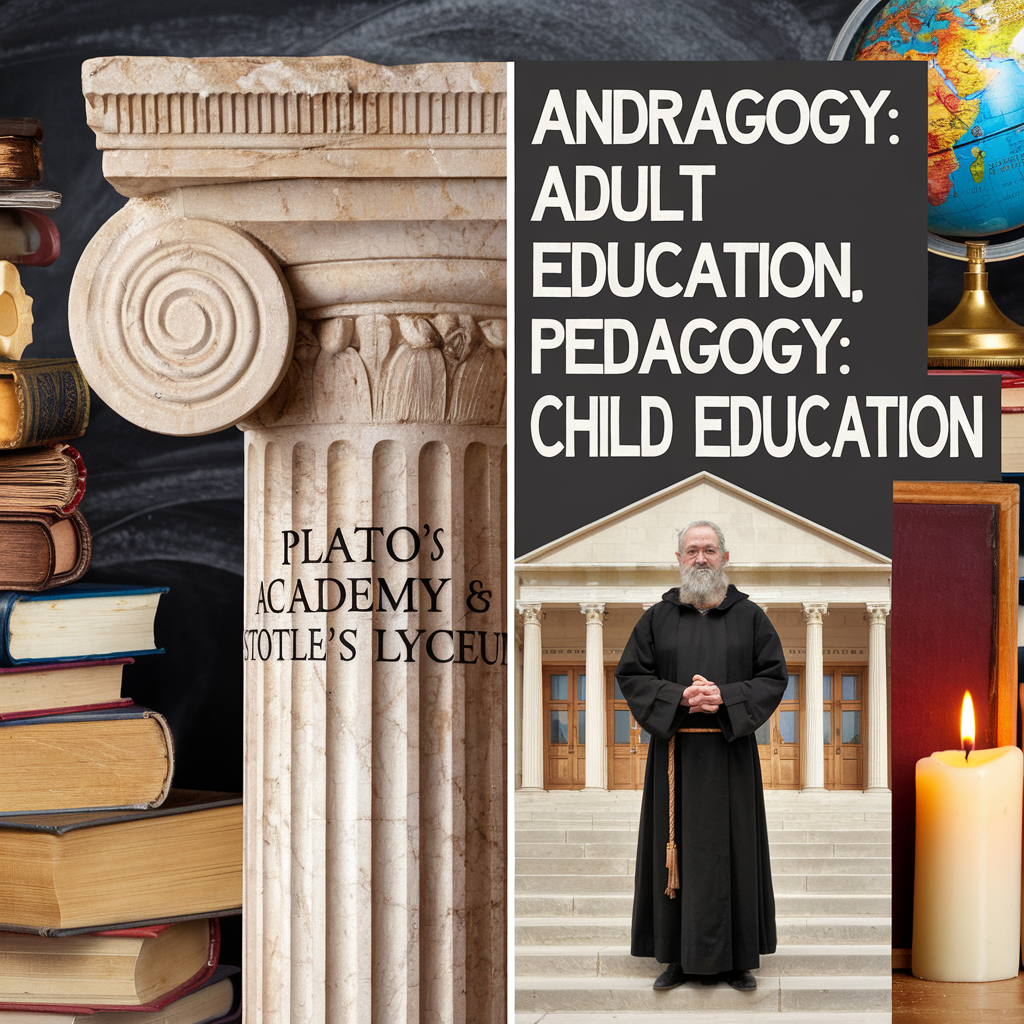

Introduction: The Roots of Education
When we think about education, we often picture classrooms filled with children. However, the origins of education tell a different story. Before formalized schooling for children, education primarily focused on adults. The terms andragogy (adult education) and pedagogy (child education) may seem modern, but their roots trace back to ancient practices and philosophies.
Did education always prioritize children, or were adults the original learners?
Ancient Education: The Age of Adult Learning
Education in ancient times was fundamentally about preparing adults for leadership, philosophical inquiry, and societal roles. According to Savicevic (2008), institutions such as Plato’s Academy and Aristotle’s Lyceum were primarily adult education centers. These institutions focused on fostering critical thinking and philosophical exploration rather than simply delivering content. Educators utilized methods like dialogue, parables, and problem-based learning—techniques still recognized as essential in modern andragogy.
Global Examples of Early Adult Education
- Greece: Plato’s Academy and Aristotle’s Lyceum were pioneering spaces for intellectual discourse, where adults engaged in philosophical and ethical inquiries.
- China: Confucius emphasized moral inquiry and dialogue, guiding adult learners toward self-cultivation and societal harmony.
- Hebrew and Christian Traditions: Religious leaders taught through parables and storytelling, engaging adults in moral and theological discussions.
I personally love the historical use of parables because of their power to simplify and make complex concepts relatable. I often use metaphors in my own teaching to help adult learners connect with abstract ideas. These methods encourage reflection and engagement, aligning with my approach to creating a collaborative learning environment.
The Shift to Pedagogy
The term pedagogy emerged much later. By the 7th century, monasteries began establishing schools specifically for children, marking a shift from adult-centered education to child-focused instruction. These institutions aimed to instill religious doctrine and basic literacy.

Why the Shift?
- Societal needs changed as communities expanded, requiring structured education for younger generations.
- Pedagogy emphasized methods like repetition, memorization, and direct instruction, which were well-suited to the developmental needs of children.
In my experience as an adult learner, I’ve encountered traces of overly rigid pedagogical methods. For example, I’ve had instructors who stuck strictly to a slide deck, discouraging questions that veered off track. This restrictive approach often shuts me down, as it leaves little room for curiosity or exploration. While pedagogy may work for children, I’ve found that adult learners thrive when the facilitator fosters dialogue and flexibility.
The Modern Legacy of Ancient Methods
Despite the formalization of pedagogy and andragogy, many methods developed in ancient times remain relevant today. Techniques like problem-solving, storytelling, and collaborative dialogue are now staples in modern education.
A Key Difference: Content vs. Process
Savicevic (2008) emphasizes a fundamental distinction between pedagogy and andragogy:
- Pedagogy: Focuses on content, where the teacher determines, organizes, delivers, and evaluates the material. The teacher is the primary authority in this model.
- Andragogy: Shifts the focus to the process, with the facilitator creating a learning environment that is physically and psychologically respectful of adult learners. Learners actively participate in planning, delivery, and evaluation, fostering engagement, self-direction, and ownership of their education.
I strive to embody these andragogical principles in my teaching by fostering a collaborative spirit. My classes emphasize shared experiences, ensuring that everyone is following along and contributing. At the end of the day, this approach is often reflected in resoundingly positive evaluations. Adult learners value a climate of respect and mutual engagement.
To explore the distinctions between pedagogy and andragogy further, I recommend watching this concise and insightful video by Academixx:
This video provides clear, relatable examples that highlight the differences between these educational approaches and their relevance today.
Conclusion
The journey from andragogy to pedagogy reveals how education has evolved to meet the needs of different learners. From the great teachers of ancient times to today’s classrooms and virtual environments, one principle remains constant: the best education is tailored to the learner.
What I hope readers take away from this blog is that everything we need to know has already been discovered centuries ago. While we may refine the definitions of educational practices, the core methods remain timeless. The best lessons are those that are tried, tested, and true.
References
- Academixx. (2022). Pedagogy VS Andragogy (with simple examples). Retrieved from https://www.youtube.com/watch?v=XigkVs_sEPo
- Henschke, J. A. (2016). A history of andragogy and its documents as they pertain to adult basic education. Retrieved from https://eric.ed.gov/?id=ED529427
- Ozuah, P. O. (2005). First, there was pedagogy and then came andragogy. The Einstein Journal of Biology and Medicine, 21(2), 83–87. Retrieved from https://core.ac.uk/download/pdf/235995148.pdf
- Reischmann, J. (2000). Andragogy: History, meaning, context, function. Retrieved from http://www.andragogy.net/
- Savicevic, D. (2008). Convergence or divergence of ideas on andragogy in different countries. International Journal of Lifelong Education, 27(4), 361–378. Retrieved from http://andragogy.net/conference2006papers/Savicevic.pdf
- Taylor, B., & Kroth, M. (2009). Andragogy’s transition into the future: Meta-analysis of andragogy and its search for a measurable instrument. Retrieved from https://eric.ed.gov/?id=EJ891073

This work is licensed under a Creative Commons Attribution-NonCommercial-ShareAlike 4.0 International License.



Leave a Reply